• Project Pan: Empties no. 1

    Project Pan: Empties no. 1

    ​During a No Buy Year I cannot forget about old-school challenge of Project Pan. Especially because I have a lot of skincare and make up products that I have purchased over the years and that are currently sitting in my stash. I would like to use as many of them as possible. I’m aware that some of them probably have expired by now, so this challenge and decluttering will be a great way to get rid of them and put overconsumption into perspective.

    Long time ago I realized that I really don’t need that many beauty products sitting on my shelves but I have been too overwhelmed to even try to go through them. But step by step we will get there!

    What is Project Pan?

    Project Pan first became popular in the online beauty community. “Panning” refers to the literal act of using a product completely until you hit the metal pan at the bottom of a powder product, for example an eyeshadow. It is a challenge where you select a specific group of items – it could be makeup, skincare, haircare or other household goods – and commit to using them up before purchasing any replacements. This way you actually use what you have.

    Empties no. 1

    In this post I will share my first empties during my No Buy Year. They’re not as impressive as I would like them to be but finishing products is a process and it takes time!
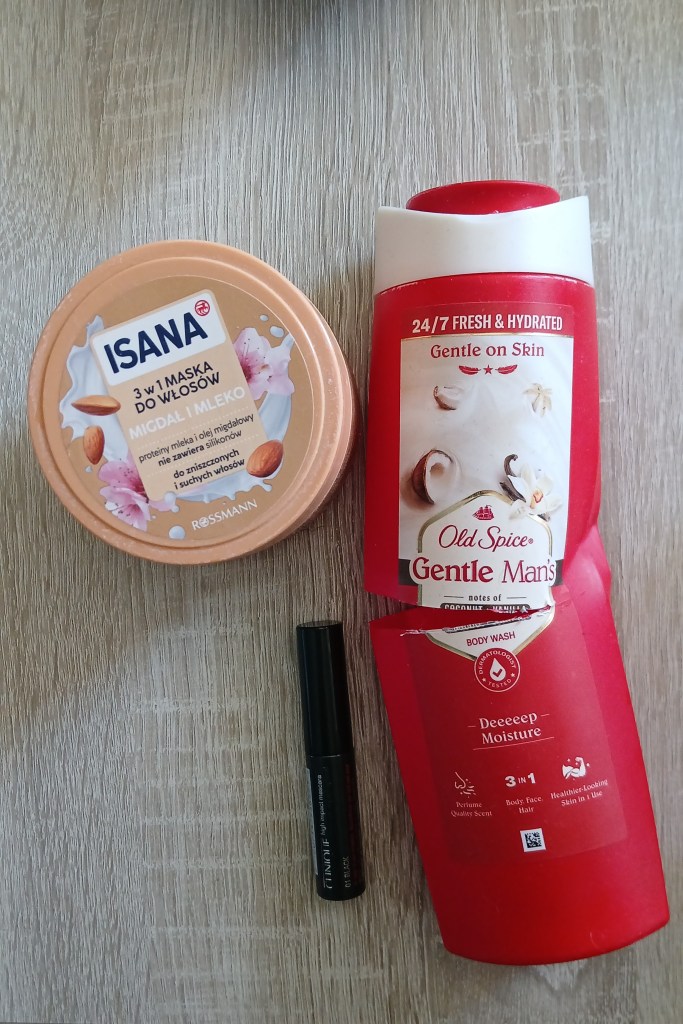
    This time I have finished 3 products:

    ISANA 3 in 1 Maska do Włosów (Migdał i Mleko) – a 3-in-1 hair mask with almond and milk protein by Rossmann. I really liked this hair mask – the smell and how this product worked is just perfect. Helped me a lot when I had to detangle my hair. For some reason (probably because I cannot get it in my country) I was “saving” it for later and using it sparingly. But now it’s gone! Yaay!

    Would I rebuy it if I didn’t have similar product in my stash? Yes!

    Old Spice Gentle Man’s Body Wash (Deeeeeep Moisture) – a 3-in-1 body wash, face and hair product with notes of coconut and vanilla. Family member left it in my shower when they visited us. We won’t see each other for months, so I decided to finish it, even though it’s a product dedicated to men. The scent wasn’t something that I would say only men can use, so it wasn’t that obvious that I was using men’s body wash.

    I had to cut through the packaging to get the rest of it out and there was significant amount left!

    Would I rebuy it? Technically I didn’t buy it in the first place. But I wouldn’t buy it for me or my husband.

    Clinique High Impact Mascara – this one wasn’t really an empty-empty. I have used it before and liked it, so I got a new one, but this time it was giving me a lot of trouble with itchiness after a while, so I decided to stop using it after trying to make it work…

    I don’t have a strict list of products to finish in my Project Pan challenge. I want most of them gone but I’m aware it will take me a long time. If you would like to follow my journey, please consider subscribing to this blog.

    I also stopped wearing make up as much as I did years ago – I can count times I wore it this year on my fingers – so I need to figure out a way to start all over again.

    Good thing for my No Buy Year is that even if I get into doing make up again, I won’t be buying new things any time soon. I’m currently discovering my stash all over again and honestly, it feels like shopping.

    I cannot sell or give away much of my collection, as those things have been opened and used at some point. For hygienic reasons it’s not a good idea to find them a new home and I would like to avoid throwing out as much as possible…

    Are you currently participating in a Project Pan? Or have you in the past? What are your thoughts about this challenge? Let me know!

    Till next time,

    xoxo,

    Aleksandra

  • Traveling On a Budget: Choosing the Right Accommodation
    Daily writing prompt
    What’s your best tip for budget travel?

    If you are traveling on a budget, booking the right accommodation for your stay can save you a lot of money. Today I will share our best travel tip that we practice for years now when going on holidays.

    Packing light and cooking your own food are the ultimate secrets to keeping travel costs from spiraling out of control. When accommodation provides kitchen space and laundry room, it is not only practical, but also saves you money.

    That’s why booking an apartment, a guesthouse or a hostel with shared kitchen facilities does more than just give you a place to rest your head. It helps you with some of the biggest budget drains on any trip: dining out and airline baggage fees, if you have access to certain facilities.

    The Kitchen

    Eating out three meals a day adds up faster than almost any other travel expense. Having a kitchen available helps you avoid expensive tourist-trap restaurants and explore local markets, getting your own groceries and cooking for yourself. Grabbing fresh produce, regional cheeses and maybe even trying local ingredients for breakfast or dinner not only saves you a significant amount of money, but it also offers an authentic slice of everyday life. You still get to enjoy a nice restaurant meal when you really want to, rather than rely on eating out everyday out of sheer convenience or hunger.

    The Laundry

    Many of these same kitchen equipped spaces also come with access to a washing machine and dryer (or at least a washing line). This minor amenity is a total game changer for packing light. Instead of dragging a heavy suitcase that can trigger steep airline baggage fees and checked bag charges, you can pack a wardrobe for a week and simply wash your clothes halfway through the trip. Even if the place you stay at doesn’t give you access to washing machine, I would pack light and wash my clothes during the trip.

    How to Find Them

    When searching on platforms like Airbnb, Booking.com or specialized hostel sites, use filters to specifically check boxes for “kitchen” and “washer.” Always read the fine print to confirm whether the washing machine is in-unit or shared on the property. Some of those accommodations provide basics you need, such as laundry detergent. Just to be safe, when we travel, we always take a small amount from our house, so we don’t have to buy it during our trips.

    What other budget friendly tips do you usually rely on when planning your trips? Let me know!

    Till next time,

    xoxo,

    Aleksandra

  • How Does Your Mindset Affect Your Financial Success
    Daily writing prompt
    How does your mindset affect your financial success?

    We like to think that managing money is purely a math problem. If you earn more than you spend, you win. But anyone who has ever stared at their bank account wondering where it all went knows that personal finance is rarely about numbers. It is about our behavior, emotions and… mindset.

    Sometimes there’s indeed “too much month at the end of the money”. But many people blame their financial problems purely on how much they earn and don’t recognize their own faults. If you suspect that you may be one of those people, a No Buy Year (Month/Quarter, whatever you pick) is a great way to rewire your brain, work on habits and potentially improve your finances.

    When you decide to commit to a No Buy challenge, you quickly realize it is not as easy as simply avoiding the stores – it is unlearning the habits that drove you there in the first place.

    The Dopamine Trap

    We all love the quick fix. That sudden rush of excitement when you click “place order” or scan your card at checkout isn’t satisfaction, it is a hit of dopamine. Our brains are hardwired to crave anticipation and reward and retail therapy offers a cheap, immediate shortcut to feeling good. I fell for that trap and currently I’m decluttering my home from all the “quick fixes” that made me feel good for maybe couple minutes. I would rather have the money I spent on those things in my savings, but harm was already done and I have to deal with it.

    People who take on No Buy Year challenge deal with different emotions that lead them to overspend and overconsume. Some of us rely on shopping to self soothe, celebrate (Birthday Month concept is truly something out of control) or cure boredom. The mindset shift happens when you stop seeking dopamine from acquisition. It is not easy to do that, don’t get me wrong. I heard that to change our habits, we need at least 21 days. That’s a long time, if you have no patience and little hiccups (e.g. “I ordered takeout today, might as well not try NBY at all”).

    Watching your savings account grow and realizing you successfully resisted an impulse buy is its own reward. But this one doesn’t leave behind clutter or buyer’s remorse.

    The Good & Bad Power of Micro

    We tend to fixate on big numbers, believing that financial success requires massive sacrifices. But what is far more dangerous are the micro purchases. That five euro coffee, the twelve euro takeout or those thirty euros spent to “treat yourself” feel like nothing in the moment. Yet, these small amounts can add up very quickly and quietly.

    I don’t know many people in my life who budget and track their spending. So they laugh about takeout coffee and avocado toasts.

    This exact mechanism works in your favor when you try to save. Squirreling away small, seemingly insignificant amounts by rounding up transactions, moving five euros into a high-yield account or skipping a single unnecessary thing to add to the clutter, creates momentum. Financial success is built through compounding habits, not overnight transformations.

    In the long run we want to create a proper budget and find out where we can save and how much we can save. But everyone started somewhere and those little choices we make everyday are therapeutic.

    Blurring of the Needs and Wants

    Going back to jokes about coffee and avocados, in consumption driven society many people confuse actual needs and wants. Marketing is working, eh? This is in my opinion one of the biggest hurdles when we try to change our mindset and improve our finances.

    When everything from a specific water bottle promoted on TikTok to a new organizational tray feels like an essential upgrade to your daily life, a No Buy Year acts as a hard reset. Stripping away the excess forces you to sit with discomfort and ask the uncomfortable question: what would happen if I simply made do with what I already have?

    Answer is very simple: you’d be better off.

    Financial success isn’t about deprivation. When you view a No Buy Year as punishment, every day is an uphill battle. But when you reframe it as an exercise in freeing up mental space, energy and resources for things that genuinely matter, your mindset shifts from restriction to abundance.

    What is the hardest part of a No Buy Year for you? Let me know! And if you’d like to follow my No Buy Year journey, please consider subscribing to this blog.

    Till next time,

    xoxo,

    Aleksandra

  • Debt

    Daily writing prompt
    What’s something you do completely differently from how you were raised?

    I grew up in a household where having (excessive) debt was normalized, due to our circumstances. My parents weren’t earning much but they needed to provide and my guess is, at some point – with all the bills piling up – they decided going into debt was the only way to do so. And for some reason banks decided it was a good idea to lend them more than could handle. It led to debt spiral that we are dealing with decades later.

    As I grew up, I recognize that having to provide is a valid reason but the point it got to feels just reckless – during the debt spiral and paying off one loan with another they seem to have given up on trying to fix the situation. And they woke up pretty late in the process, making them lose so much money in interest payments and any opportunity to save up… Situation is more under control now and most of the debt is paid off now but it took its toll on how I view money for sure.

    Even if it was painful, it was an important lesson for me, going through this as a teenager. On my own, I have never had a credit card. Taking out any loan feels dangerous. I have had two loans in my life that I paid off and I refuse to take any in the future. I wish I had money saved up back then and could have paid outright for things I needed those loans to cover. I would rather go without, than go into debt. What if I end up spiraling just like my parents did?

    As I mentioned in my introduction to my No Buy Year, we are looking into buying a house with my husband. Mortgage also scares me but there’s no other way for us to do it – buying cash is definitely not an option. I don’t play the lottery. So mortgage it is…

    We try to plan our finances carefully and assess all the costs upfront. As we were talking about certain things we need to get and do, I declared that we should put off and save up for some of them. We can wait couple more months after we close for certain things and we don’t need to get them right away. It would be nice to be able to do that, but our budget is tight.

    And then my husband said “I can go into red in my account”. No, honey, you cannot. I quickly tried to extinguish this idea in his mind. Going into red in your account, while we take on a huge amount of debt like mortgage is just a first step to spiral, just like my parents did. I guess being poor taught me more patience than he can exhibit. We grew up in completely different households. You wait for the next paycheck. You wait with big purchases. You simply don’t have the money. It’s okay. It can wait. You can wait for a miracle. Money is scary.

    That’s why budgeting and saving money is important to me. Learn from other’s mistakes. Go without. I cannot say that I have been doing great in this regard and I have definitely used shopping as a therapy in the past but No Buy Year is the year of changing habits. I document my journey on this blog. If you’d like to join me, please consider subscribing to this blog.

    Till next time!

    xoxo,

    Aleksandra

  • Every winter I have the same problem – I don’t have a warm winter jacket that I can wear outside of work… I work in a warehouse and in the winter it gets very cold (no heating), so I end up wearing my winter coat at work. It is also pretty dirty work and I tore clothes all the time, so simply washing it more often is not a solution.

    Because of my working conditions and how they impact my clothes, last year I had to get rid of three winter jackets, because they got torn. And I ended up using my “good” coat at work…

    That’s why this year I decided to get a new winter jacket. That may seem to be against No Buy Year philosophy but hear me out – I don’t think we should put off necessary purchases if we can afford it. I just refuse to buy anything brand new for myself if there are no hygienic concerns (clothes) or it was a planned purchase for our household.

    I ended up getting two – one short winter jacket and one parka, as we are going for holidays to a colder country. But since I started using Vinted more actively than before to offload my “collections” of unnecessary things and my goals to save as much money as possible, I decided to give it a shot. And I think I got a great deal, as for two winter jackets I paid around 80 euros including shipping – less than I would have for one of them, if they came from a shop.

    They’re “name brand” items but I have had good experiences with those brands before when it comes to clothes and for the winter I would like to have something that is not a thin coat… That’s my main problem with shopping for winter clothes – most of them are not warm enough and I end up layering so much, it’s ridiculous.

    Both parcels have arrived this week. One came from a local seller from The Netherlands, the other came from France. I already checked them (I try to do it as soon as I can and be able to click that “everything is okay”, so Vinted releases the funds to the seller) and for a second hand winter jackets, I think I got very good deals. They had slight marks but they came off with one washing cycle (which I would do anyways). Except for that, they were as described and in a very good condition for a used item. I hope that they will last me for a long time, as I don’t plan to wear them at work.

    My Tips For Buying (and Selling) Safely on Vinted

    So far, as a seller and buyer on Vinted, I’m very happy with the app. I’ve interacted with very nice people on both sides of the transaction. And so far I haven’t had any issues with items being significantly not as described or someone trying to scam me. I really hope it stays this way, because I have seen plenty of horror stories on Reddit and Facebook groups.

    When buying on Vinted, I look at both pictures and item descriptions. The more pictures, the better, of course. If there are no pictures available, aside from the main photo, I skip buying the item.

    I also check the reviews of the seller. Some people are just starting out, so when everything goes well, I make sure to add my own review as soon as I accept the item. I don’t expect flawless 5 star rating but I pay attention what the issue was – was it automated cancelation review or did someone buy something and had a bad experience? Reviews from humans matter a lot.

    One more important thing – check when the seller was active last time. Some people forget they have a Vinted account. If the seller wasn’t active in more than couple days, I send an offer first and see if they log back in to respond.

    Problems always can come up and my way of shopping on Vinted is not the solution for all of them. Items can get damaged in transit, parcels get lost all the time. But so far paying attention to those details paid off.

    And I try to do the same as a seller – take as many pictures as possible, provide all information I have about the item I’m selling and be honest about its condition. That’s really all you can do.

    So if you need a wardrobe refresh, I would highly recommend shopping second hand and not buying new this year. Lately we also have been checking out furniture stores and boy, oh boy, I have thoughts. If you’re curious about them or if you want to follow my No Buy Year journey, please consider subscribing to this blog.

    Till next time!

    xoxo,

    Aleksandra

  • This topic is very frustrating for me and I had to think if I even want to write about it on my blog. On August 12th 2026 European Union backstabbed small business based in EU once again. New packaging and recycling regulations require everyone – no exemption – to have a representative in a country a business ships to. And having a representative comes with a hefty price.

    If you run a small, independent online shop, you already know how difficult it is to compete. Between platform fees, shipping rate hikes, the constant hustle of creating or curating your products and trying to find your audience, every sale matters. For some reason my handmade products are more popular in bordering countries. That’s why I registered and paid the recycling fees based on “old” regulations. But for European Union that wasn’t enough – now I have to stop shipping abroad all together. And I know I am far from the only one.

    The Illusion of the “Small Business” Exemption

    Under the EU’s framework, including the rules surrounding Extended Producer Responsibility (EPR) and the newer Packaging and Packaging Waste Regulation (PPWR), regulatory bodies often point to carve-outs for “small businesses”.

    The catch? According to the EU definition, a “small business” or micro-enterprise can pull in up to 2 million euros in revenue per year and have up to 9 employees.

    To a multinational corporation or a mid-sized e-commerce brand, 2 million euros is small. But to a solo maker, even if it is a registered business, or a tiny creative studio shipping a few parcels a month (if that), that definition is entirely detached from reality.

    When you operate a micro-business, you are the customer service department, the shipping clerk, the accountant and the creator. You don’t have a compliance department or a legal team.

    Yet, under the implemented system, selling a single lightweight package across an EU border triggers a staggering bureaucratic chain reaction.

    You are now expected to register separately in the national producer registry of every single EU country you ship to. You are require to hire and pay for a local authorized representative (and it can cost thousands per year per country). You face annual baseline fees and administrative overheads that bear zero relation to your actual physical impact or sales volume.

    And there’s no micro-business exemption. If I sell five items a year to customers in three different EU countries, the fixed compliance and registration costs alone would put me into debt. Yes, small guys like me pay the same rates big corporations do. That’s why I turned international shipping off on my website and in my Etsy Shop.

    The Environmental Irony

    The stated goal of these regulations is noble: to reduce packaging waste and hold producers accountable for their environmental footprint. As someone writing about a “No Buy Year” and sustainability, I deeply care about waste reduction.

    But punishing low volume EUROPEAN creators does nothing to curb industrial waste. Massive corporations that mass-produce single use plastics can easily absorb these compliance costs as a routine line item in their accounting. Meanwhile, a local maker shipping handmade goods is priced out of international trade entirely.

    Instead of targeting massive polluters where the actual volume and waste sits, the current regulations create invisible trade barriers within Europe, suffocating ecosystem of independent artisans and micro-entrepreneurs. And, in my opinion, goes against the fundamentals and reasons why European Union has been created in the first place.

    Stopping cross-border shipments to the EU wasn’t a choice I wanted to make. I love knowing that my work has found homes in other countries and meet people who appreciate my work. But as a micro-business owner, I have to be realistic. I cannot afford that. When regulation treats a solo operation shipping 10 boxes a year the same way it treats a multinational shipping 10 million, the math simply stops working.

    If policies don’t evolve to recognize true micro-operations, for example by introducing sensible de minimis weight thresholds or simplified, single-window European registries, we risk erasing the independent maker economy entirely.

    We will be stuck with Aliexpress, Temu and Amazon landfill loop. This new regulation was disguised as a way to fight with big corporations flooding our market with cheap (sometimes dangerous) goods, without any consequences. Instead, it’s only helping them dominate the market.

    It is a frustrating topic for me, because European Union betrayed us once again. As a part of my No Buy Year, I won’t be spending any money on this ridiculousness. Instead, I’m considering my choices and will probably close my operation all together.

  • ​If you visit my apartment, one thing will be pretty obvious – I’m a crafter. I mainly crochet and experiment with wooden creations but I have also tried other crafts. Even though handmade things bring me joy and that won’t change during my No Buy Year, long time ago I realized that me seeking joy and dopamine has gotten a little bit out of hand. I have closets full of crafting supplies I never actually touched. My hobby had crossed the fine line between “passionate creator” and “accidental hoarder”.​

    Buying the supplies felt just as good as doing the craft. But staring at unopened supplies weighed heavily on me, making me feel guilty for wasting resources and money on so many things…

    ​That realization sparked a massive decluttering mission and Vinted helped me heavily with tackling the problem.

    ​​Keeping all those items felt counterproductive. I couldn’t bring myself to throw them away – that is obviously wasteful. I needed a middle ground. I needed to decide what to keep and send items I won’t use to homes where they would actually be appreciated.​

    The Vinted Reality Check: Summer Slump vs. Success​

    Starting a Vinted clear-out in the middle of summer is usually not recommended. People are away on holidays and scrolling through second-hand apps is rarely top of mind. Also, people spend money on holidays themselves and may not have enough disposable income to buy unnecessary things. I didn’t have high hopes.​

    Yet, to my absolute surprise, the momentum has been incredible: in just two months I have shipped out and rehomed 113 items. Let’s be real – I am certainly not getting rich off this. Many of my craft supplies and smaller items are listed for as low as €1.50. But my primary goal isn’t profit; it’s to stop being wasteful. I price things low because I know buyers still have to factor in Vinted’s buyer protection fee and shipping costs. Even though shipping has gotten noticeably more expensive lately, Vinted rates are still far cheaper than traditional postal services, making it a win-win for everyone.

    Letting things go feels good. It kind of became a new hobby of mine.​

    Decluttering my hoard hasn’t just cleared physical space in my home; it has given me immense mental clarity. Seeing those 113 items packed up and sent off to new homes feels like a massive victory, because I have been postponing it for way too long.

    ​Have you ever decluttered a massive stash of unused hobby supplies or are they currently staring back at you with judgment too? Let me know in the comments below!

    Till next time!

    xoxo,

    Aleksandra

  • Daily writing prompt
    What’s a moment when you realized you were officially an adult?

    I honestly don’t know if I had one exact moment when I realized that I’m officially an adult. I’m currently in my early 30’s and I feel like I have wasted too much time already not building up my adult life.

    We become adults and gain certain rights (right to vote, get certain categories of driving licenses, buy alcohol) at 18. We can decide to pursue higher education or go into the workforce. At 18 nobody is stopping us from making mistakes. We are adults after all.

    One failed exam stopped me from getting higher education. And because at 18 I didn’t feel capable of passing it at all, ever, no one could make me retry. So I decided to start working instead.

    And to be honest, even if I passed that particular exam and went to university, I would probably choose a carrier that wouldn’t pay much either. I have seen many such cases in my circle at the time – higher degree but no job in sight…

    Because I was an adult, no one could force me to spend money I earn in a certain way. And I’m pretty sure if I got myself into trouble, my parents would try to bail me out. An adult, not the most responsible one.

    Luckily for me, I had enough common sense not to get myself into debt during my early 20’s. No loans, no credit cards. Also no savings or a plan for the rest of my life. I was coasting for years, legally an adult but mentally a child.

    Couple years ago I finally realized that if I don’t change, my situation won’t get better on its own. And I guess that was the moment when I realized that I’m officially an adult. Responsible for how my life looks like. Not wanting to be a burden to others. And even though I still don’t have a degree and work minimum wage shitty jobs, bit by bit, I’m trying to build a better life for myself. I realized that all those little choices we make daily sum up to how our lives look like. And that there’s no going back…

    I’m sharing my adulting journey here, so if you want to stay tuned, please consider subscribing to this blog.

    Till next time!

    xoxo,

    Aleksandra

  • I have to admit that this is not the first time that I start this project, called No Buy Year. Some of you may be familiar with this concept, as it has been a popular way to save money and change habits for many years now. This blog is a way for me to document my progress along the way.

    No Buy Year can be what we want it to be – we can completely cut off unnecessary spending or focus on certain categories of expenses and use what we already . The rules that I have set for my No Buy Year are simple – no unnecessary spending in all categories and focus on saving every single cent possible.

    Together with my husband we recently started an exciting and very stressful journey of trying to buy our first house. I have to admit that our savings are not where I would like them to be before taking this very important step. Years of mistakes, impulsive purchases and shopping “therapy” definitely show through our savings account balance.

    Fortunately we never got into significant debt, except for his student loans, and everything else has been long paid off.I won’t disclose our full financial situation while writing about my No Buy Year journey. I don’t think it is wise to share the exact numbers with entire world but one thing I can tell you about me is that I never finished higher education or trade school. I’m in my early 30’s and still work a job that is paid just couple cents more than legal minimum wage.

    That’s why I thought it would be beneficial to some of you to read about my experience and how in 2026 I still can put some money aside, even working one of the lowest paid jobs.

    And maybe the fact that I will not disclose the full details is going to turn some people off, but I’m going to share my ways to save on daily expenses, as well as my journey with decluttering and downsizing. This can be inspiring and still insightful, that’s why I decided to start No Buy Year blog.

    One personal detail from my life – I came to The Netherlands in 2019 with one suitcase, one backpack and a sleeping bag. When I think about how I came from one plate, one fork and one spoon to having to declutter my hobby stuff “collection”, it has to do a lot with emotional spending. The fact that I met my husband here and we settled together in a pretty good rental situation didn’t help with staying frugal. I will share more about that in the future, so if you are interested in following my journey, please consider subscribing to this blog.

    Till next time!

    xoxo,

    Aleksandra